
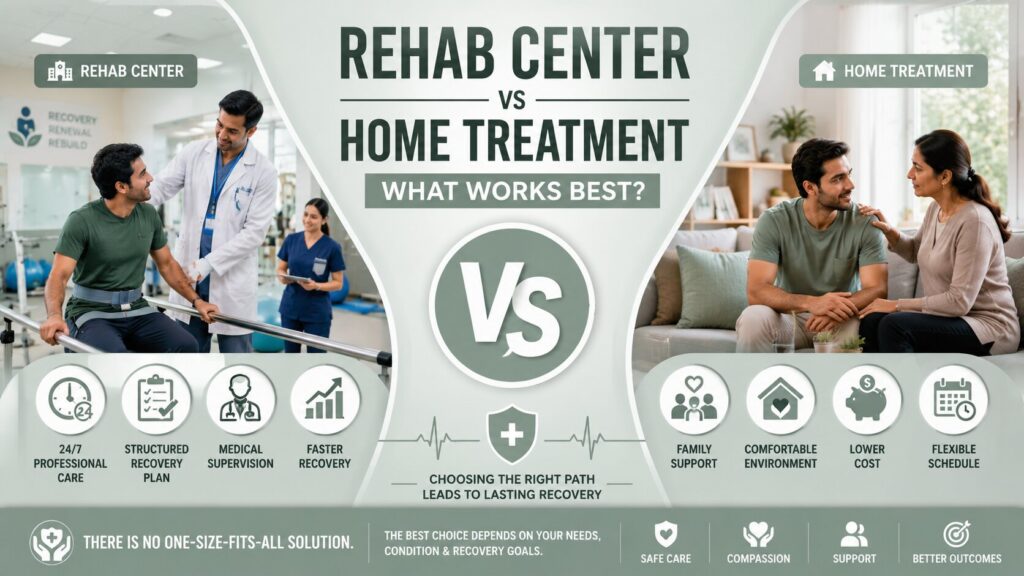
When a family in Bangladesh first realizes a loved one has a drug or alcohol problem, the first instinct is rarely “send them to a rehab center.” It’s usually something closer to: can we fix this at home, quietly, without anyone finding out? That instinct is understandable. It comes from love, from fear of social stigma, and often from a genuine belief that home is where healing should happen. But after working with families across Dhaka, Mirpur, Gulshan, Dhanmondi and beyond for over 13 years, we can say this plainly: home treatment and professional rehab are not interchangeable options. They solve different problems, and choosing the wrong one can cost real time, money and in some cases, a life. This article breaks down what each approach actually involves, where home-based efforts genuinely help, where they fall short medically, and how to decide what your family needs right now.
What “Home Treatment” Actually Means
Home treatment usually looks like one of these:
- A family member trying to get the person to “just stop” through willpower and supervision
- Locking away money, restricting movement, or constant monitoring
- Religious or spiritual counseling at home without medical involvement
- Using home remedies, herbal mixtures, or unsupervised tapering to manage withdrawal
- Informal support from friends or community members who’ve struggled with addiction themselves
None of this is inherently wrong. Family involvement and emotional support are part of every real recovery. The problem is what’s missing: medical supervision during withdrawal, structured therapy, and an environment separated from the triggers that fed the addiction in the first place.
What a Licensed Rehab Center Actually Provides
A proper rehab center is a licensed medical facility, not a place where someone is simply “kept away” from substances. At AMAR Home, treatment runs through three clinical phases:
- Stabilization — medically supervised detox under a resident medical officer and psychiatrist
- Rehabilitation — structured therapy (CBT, DBT, Motivational Interviewing, 12-Step Facilitation) combined with yoga, meditation, and nutrition support
- Aftercare — relapse-prevention planning, alumni community support, and ongoing family counseling
This isn’t a generic process. Every patient is assessed individually before a treatment plan is built, because a 22-year-old with a yaba dependency and a 45-year-old managing long-term alcohol use disorder need fundamentally different care.
Why Withdrawal Is the Real Risk Point
This is the part most families underestimate, and it’s also the most medically important fact in this entire comparison. Withdrawal from alcohol, sedatives, and benzodiazepines can be physically dangerous without medical supervision. Seizures, severe dehydration, and cardiac complications are real risks during unsupervised withdrawal — not rare exceptions. Opioid withdrawal (heroin, prescription painkillers) carries serious overdose risk both during use and immediately after a period of abstinence, which is exactly what happens when someone tries to “detox” at home without medical backup.
This is precisely why every patient who enters AMAR Home’s Long-Term or Intensive Program goes through detox under direct supervision from our medical officer, with our psychiatrist conducting scheduled clinical assessments throughout treatment. Home environments, no matter how loving, are not equipped to manage these risks.
Where Home Support Still Matters — Just Not as a Substitute
We’re not telling families to step back. The opposite is true. Family involvement is built directly into how we treat patients:
- Monthly family counseling sessions during residential treatment
- Family visits permitted from day 45 onward
- A structured Brotherhood Program connecting alumni for long-term peer support
- Practical guidance for families on how to support recovery after discharge
The reason phone contact isn’t permitted in the first 45 days isn’t to cut families out. It’s a clinical decision: early recovery requires the patient’s full focus, without the emotional pull of home routines and relationships that may have unintentionally reinforced the addiction cycle. Family support works best when it’s introduced at the right clinical stage, not from day one.
A Side-by-Side Comparison
| Factor | Home Treatment | Rehab Center (AMAR Home) |
|---|---|---|
| Medical detox supervision | Not available | Resident medical officer + psychiatrist, daily monitoring |
| Risk during withdrawal | High for alcohol, sedatives, opioids | Managed under 24-hour clinical care |
| Structured therapy (CBT, DBT, MI) | Rarely available | Daily individual and group sessions |
| Separation from triggers and access | Difficult to maintain | Built into residential structure |
| Family involvement | Constant, but often unstructured | Scheduled counseling, phased visitation |
| Aftercare and relapse prevention | Informal, inconsistent | Structured 2-month aftercare, alumni community |
| Confidentiality | Depends on the household | Full confidentiality, written-consent policy |
| Documented outcomes | None | 1,154 patients treated since 2012; 55% measured sobriety at two-year follow-up |
What the Evidence Actually Shows
Globally, addiction medicine treats substance use disorder as a chronic medical condition, not a matter of discipline. Organizations like the World Health Organization and national health bodies consistently recommend medically supervised detox followed by structured behavioral therapy as the standard of care, particularly for alcohol, opioid, and sedative dependency where withdrawal carries physical risk.
In Bangladesh specifically, yaba dependency develops fast and often involves underlying psychological patterns that need professional intervention, not just abstinence. This is part of why AMAR Home’s clinical team includes practicing psychiatrists from BSMMU and the National Institute of Mental Health (NIMH) addiction here is rarely a standalone issue. It’s frequently connected to anxiety, trauma, or undiagnosed mental health conditions that home environments aren’t equipped to identify, let alone treat.
So, Which One Actually Works Best?
For mild, early-stage substance use with no withdrawal risk, home support paired with outpatient counseling can sometimes be appropriate, but this should still be guided by a medical professional’s assessment, not decided informally by the family.
For moderate to severe dependency and this includes most cases of yaba, heroin, alcohol, and sedative addiction we see in Bangladesh — a licensed rehab center is not the “stricter” option. It’s the medically appropriate one. The structure, supervision, and separation from triggers that a home simply cannot replicate are often what make the difference between a relapse cycle and lasting recovery. At AMAR Home, Our approach has never been about telling families what they want to hear. It’s about giving an honest answer based on what we’ve actually measured over 13 years of treating patients in Uttara, Dhaka.
Frequently Asked Questions
Can addiction be treated successfully at home without rehab?
For very early-stage use with no physical withdrawal risk, some progress is possible with strong family support and outpatient counseling. For moderate to severe dependency on alcohol, yaba, heroin, or sedatives, home treatment alone is not considered medically sufficient, primarily because withdrawal management and structured therapy require professional supervision.
Is detoxing at home dangerous?
Yes, for certain substances. Alcohol, benzodiazepines, and sleeping pill withdrawal can cause seizures and other serious complications without medical supervision. Opioid withdrawal carries significant overdose risk. This is one of the main reasons rehab centers manage detox under direct clinical oversight rather than leaving it to families.
How is a rehab center different from just “checking someone in” somewhere?
A licensed rehab center like AMAR Home operates under government licensing (DNC) and independent quality certification (ISO 9001:2015), with a psychiatrist-led clinical team, individualized treatment plans, and measured long-term outcomes. It’s a medical and therapeutic process, not custodial supervision.
What role do families play once someone enters rehab?
An active one, but at the right stage. AMAR Home holds monthly family counseling sessions, permits visits from day 45 onward, and provides practical guidance for supporting recovery after discharge. The early no-contact period exists to protect the patient’s focus during the most vulnerable phase of treatment.
How do I know if my loved one needs a rehab center instead of home support?
If there’s any history of withdrawal symptoms, repeated failed attempts to stop, dependency on alcohol, yaba, heroin, sedatives, or other substances, or co-occurring mental health concerns, a professional clinical assessment is the right next step — not a home-based decision made under stress. AMAR Home’s admission coordinator handles every initial consultation personally and can help determine the appropriate level of care.